
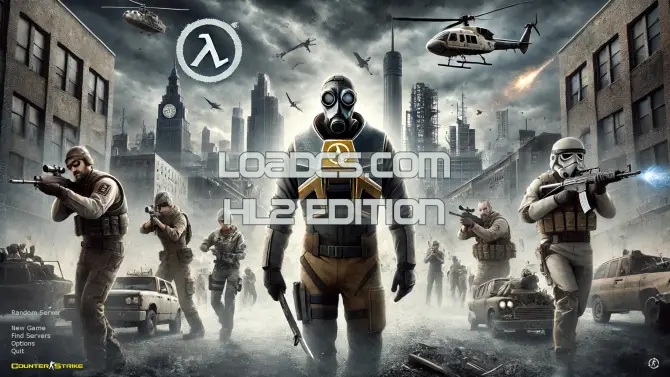
Few PC games have left a legacy as powerful as the original Half-Life. Released by Valve in 1998, the game appeared during an era when first-person shooters were already popular, yet it immediately felt different from most of its competitors. Instead of presenting a simple sequence of combat arenas, Half-Life created a continuous science-fiction adventure filled with exploration, puzzles, scripted events, and memorable enemies. Players interested in experiencing this classic today can download Half Life and discover why Black Mesa became one of gaming’s most famous locations.
The game places the player in the role of Gordon Freeman, a theoretical physicist employed at the enormous Black Mesa Research Facility. Gordon is not introduced as a soldier or an experienced action hero. He is simply a scientist arriving for work, which makes the events that follow feel much more dramatic. Anyone searching for a half life download will encounter one of the most recognizable openings in PC gaming: a long tram ride through the underground Black Mesa complex.
During this journey, the player sees laboratories, industrial machinery, security checkpoints, scientists, and enormous sections of the facility operating normally. Valve deliberately avoids rushing into combat. Instead, the opening establishes Black Mesa as a believable workplace before everything goes wrong.
Gordon eventually reaches the Anomalous Materials laboratory and takes part in an experiment involving a mysterious crystal sample. The procedure causes a catastrophic Resonance Cascade, tearing open dimensional portals and connecting Earth with an alien world known as Xen. Creatures suddenly begin appearing throughout Black Mesa, equipment explodes, corridors collapse, and surviving employees struggle to escape.
From this point onward, the player must travel through the damaged facility while searching for a way out. Half-Life constantly changes its environments, taking Gordon through laboratories, offices, storage rooms, ventilation shafts, underground tunnels, railway systems, industrial chambers, and eventually outdoor military areas.
One reason the game became so influential was its storytelling. Half-Life rarely stops gameplay to show a traditional cinematic. Instead, events unfold while the player remains in control. Scientists speak directly to Gordon, monsters attack people nearby, soldiers communicate with one another, and important events happen naturally inside the environment.
This technique created an unusual level of immersion for a game released in the late 1990s. The player feels as though the Black Mesa disaster is happening around them rather than being explained through separate cutscenes.
Half-Life also introduced a memorable collection of enemies. The Headcrab is perhaps the most famous. These small creatures leap toward humans and transform their victims into dangerous zombie-like hosts. Other alien enemies include Bullsquids, Houndeyes, Barnacles, Vortigaunts, and heavily armed Alien Grunts.
However, the aliens are only part of the danger. Military units are eventually sent into Black Mesa, and Gordon soon discovers that their mission is not simply to rescue survivors. Soldiers begin eliminating witnesses and hunting Gordon throughout the facility.
Human soldiers were impressive opponents for the time. They could move between positions, use grenades, communicate during battles, and take advantage of cover. Their behavior helped make combat feel less predictable than the straightforward enemy encounters found in many earlier shooters.
Gordon gradually obtains a varied arsenal. His first major weapon is the iconic crowbar, which can break crates, destroy obstacles, and eliminate weaker enemies. Later weapons include pistols, shotguns, submachine guns, grenades, explosives, a powerful revolver, experimental energy weapons, and alien technology.
Despite its reputation as a shooter, Half-Life contains plenty of puzzles and exploration. Players frequently need to operate machinery, restore electrical systems, activate elevators, move through ventilation ducts, or use environmental objects to overcome dangerous situations.
Some of the most memorable chapters are built around these mechanics. In “Blast Pit,” Gordon faces an enormous creature with long tentacles that responds to sound. Simply shooting at it is ineffective. Instead, the player must explore nearby areas and activate machinery capable of destroying the creature.
Later, “Surface Tension” greatly expands the scale of the conflict. Gordon reaches the surface of Black Mesa and encounters helicopters, armored vehicles, soldiers, defensive installations, and alien forces. Battles become larger and more chaotic, demonstrating that the Resonance Cascade has developed into something far more serious than a laboratory accident.
Atmosphere is another major reason Half-Life remains memorable. Emergency alarms, machinery, distant explosions, radio communication, footsteps, and alien noises constantly remind the player that Black Mesa is dangerous. Quiet corridors can suddenly turn into intense battles, making exploration feel unpredictable.
The mysterious G-Man adds another layer to the story. Throughout Gordon’s journey, this strange man in a suit occasionally appears in distant or inaccessible areas. He watches Gordon but rarely interacts with him directly. His presence suggests that someone has been observing the Black Mesa incident from the beginning.
Eventually, Gordon travels through a dimensional portal to Xen. This alien environment is dramatically different from Black Mesa, featuring floating islands, unusual gravity, strange organisms, and massive alien structures. Gordon’s journey eventually leads him to the Nihilanth, a powerful creature connected to the invasion.
After the final confrontation, the G-Man appears once again and offers Gordon employment. The mysterious ending raises more questions than it answers and became the foundation for the story continued years later in Half-Life 2.
Half-Life’s influence extends far beyond its campaign. The game developed an enormous modding community, with players creating custom maps, new adventures, and entirely different multiplayer experiences. Counter-Strike famously began as a Half-Life modification before growing into one of the world’s most successful competitive shooter franchises.
Other projects such as Sven Co-op, Team Fortress Classic, Day of Defeat, and Natural Selection further demonstrated how flexible Half-Life’s technology could be.
More than two decades after its original release, Half-Life remains an important part of gaming history. Its graphics naturally show their age, but its atmosphere, pacing, level design, enemy variety, and environmental storytelling still demonstrate why the game received so much attention.
Half-Life proved that a first-person shooter could be more than a collection of weapons and enemies. It could create a believable world, tell a story without constantly interrupting gameplay, and make players feel like active participants in a science-fiction adventure. That combination turned Gordon Freeman’s escape from Black Mesa into one of the defining experiences of classic PC gaming.